


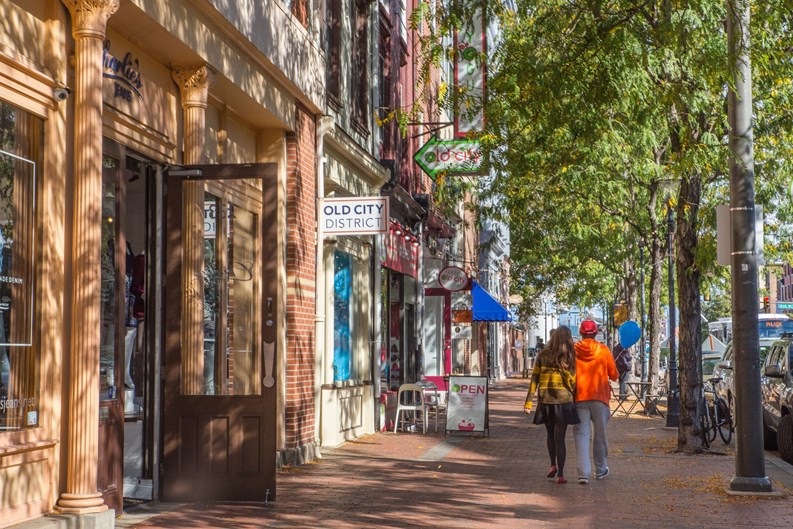
To walk down the cobblestone streets of Philadelphia's Old City today is to experience one of the country's most successful experiments in adaptive reuse. Long before it was the city's epicenter of luxury loft living, this historic district—bounded by Walnut Street to the south, Vine Street to the north, the Delaware River to the east, and 6th Street to the west—was known simply as Philly's “Warehouse District.”
Old City is one of Philadelphia's oldest and most storied neighborhoods, home to Elfreth's Alley, the oldest continually inhabited street in America. Its architectural bones were laid in the 18th and 19th centuries, and by the late 1800s, the neighborhood was a bustling commercial hub dominated by dry goods wholesalers, printers, publishers, and manufacturing firms housed in heavy timber-framed and cast-iron industrial buildings situated along narrow alleyways.
By the mid-20th century, however, modern transportation shifted manufacturing away from urban riverfronts, and Old City's massive stone-and-brick industrial complexes fell silent, leaving behind a neighborhood of vacant, decaying architectural relics.
A Mid-Century Shift
The area's resurrection began in the 1970s and 80s when, as so often happens in these types of neighborhoods, artists, craftspeople, and pioneering urbanites began occupying these abandoned industrial spaces, drawn by their soaring 12-to-17-foot ceilings, massive timber beams, and exposed brick walls and investing “sweat equity” to convert open-floor industrial warehouses into rustic residential lofts.
Recognizing the architectural significance of this transformation, the Old City Historic District was added to the National Register of Historic Places in 1972. By the 1990s and early 2000s, commercial developers had taken notice, and seeking to cash in on the cachet, launched a wave of formalized luxury condominium conversions.
Among the most notable transformations was The Wireworks, a historic wire manufacturing plant on the northwest corner of 3rd and Race Streets that was converted to condos in the mid-1980s. BridgeView Place was a converted warehouse at 315 New Street just south of the Benjamin Franklin Bridge that came to market in the late 1980s, and Waterbridge Court at 20 S. Letitia Street—a small historic alleyway between Front and 2nd Streets, running between Market and Chestnut Streets—was converted in 1985 and underwent a major building-wide interior renovation in 2014. These buildings and others like them preserved the industrial history of their facades and framing while integrating modern elevators, HVAC systems, and secure lobbies, creating a distinct old-meets-new residential footprint.
Demographic Shifts & Pricing
As Old City's physical environment has shifted, so have the neighborhood's demographics. The working-class manufacturing core of the early 20th century and the bohemian artist enclave of the late 1970s have gradually given way to a base of affluent young professionals and design-minded empty-nesters.
This demographic transition has in turn altered the local real estate market. In the early 2000s, buyers could secure raw or semi-finished loft spaces for less than $200 per square foot. As gentrification accelerated, pricing escalated as well. By early 2026, the median sale price for two-bedroom, two-bathroom homes in Old City hovered around $420,000 to $430,000, with well-appointed multi-bedroom historic conversions on prime blocks regularly commanding upwards of $650,000 or $700,000. Prices jump significantly for units with three or more bedrooms, and sprawling 2,000+ square foot custom timber lofts or penthouses can easily go for upwards of $1.5 million.
These days, the median sale price per square foot has stabilized near $407, making the neighborhood a resilient, high-value pocket of urban real estate. While broader Philadelphia residential vacancy rates sit between 4% and 7%, Old City's historic buildings are heavily protected by the Philadelphia Historical Commission, making it extremely tough for developers to tear down existing structures to make way for massive new condo towers. This keeps the neighborhood's inventory restricted and its property values stable.
The lack of towering steel-and-glass skyscrapers like those of Rittenhouse or West Market has also helped Old City retain its very walkable, human-scale layout. The neighborhood's vibe today is a unique blend of historic and contemporary charm, with cobblestone streets framed by independent art galleries, design studios, upscale boutiques, and some of the city's most acclaimed dining spots, giving residents the distinct privilege of living directly inside the physical history of Philadelphia.


Leave a Comment